
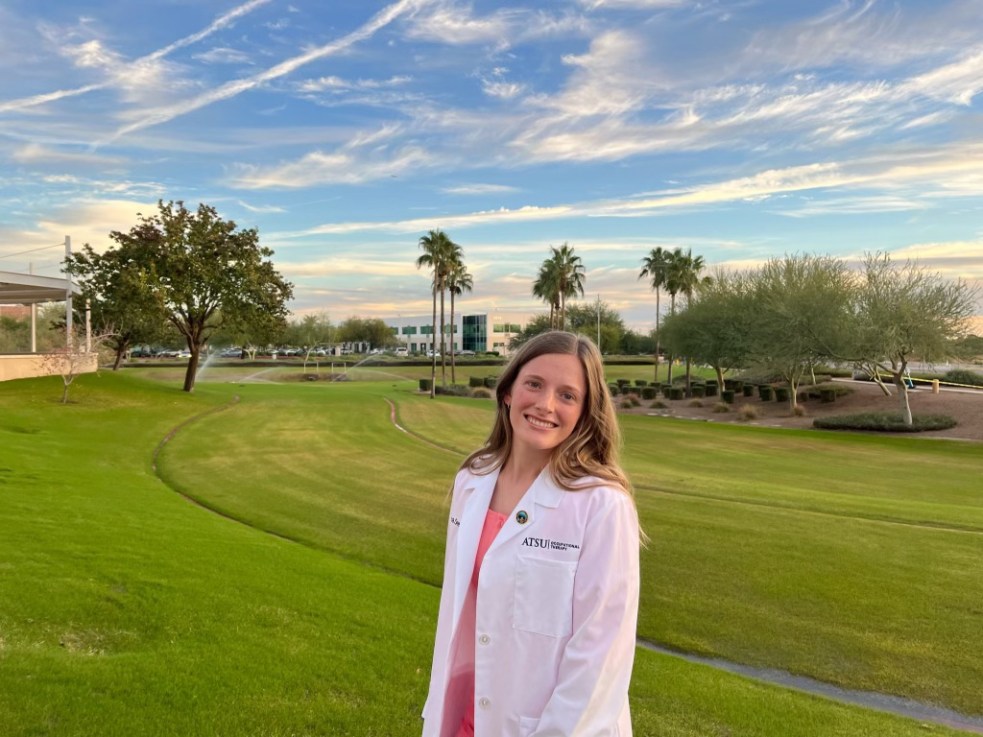
Hello, Renrenspeakers! I cannot believe it is the LAST SATURDAY of Occupational Therapy Month, let alone April! The month has just flown by like crazy! Part 4 of the Occupational Therapy Speaks mini blog series – CAPSTONE Edition has arrived! On today’s post, we will be learning about Anna, a super kind, warm-spirited colleague of mine who will be incorporating the arts into her capstone project! Today I am so excited to share her story on the blog!
Irene: What is your name/pronouns?
Anna: Anna Seedall (she/her)
Irene: Give us a quick synopsis of who YOU ARE!
Anna: I am from Idaho Falls, ID. For the last few years, I have been attending school at A.T. Still University in Mesa, AZ. I have 5 sisters, no brothers. My sisters are some of my best friends (and worst critics). I grew up doing ballet and I love the discipline, structure, and grace that it provides. I enjoy hiking, trying new restaurants, paddle boarding, and going to concerts.
Irene: Why OT? Tell us a little bit about how you found OT and what got you into this field.
Anna: A family friend recommended that I look into OT while I was in high school. She had a son on the autism spectrum and I loved interacting and engaging with him when they would come over. After figuring out what OT actually was, I was hooked. I loved how diverse and personal this profession is.
Irene: Choose three words that come to mind when you think of occupational therapy. Define each word in relation to OT. Why did you choose these three words?
Anna: Adaptable, creative, and inquisitive
- Adaptable- OTs are the most adaptable people I know. I can’t count the times that I have seen a therapist completely switch their session plan to better suit their client’s needs. This is such an important skill! Nothing ever goes as planned and being able to make changes based on what’s best for the client can make a session much more meaningful.
- Creative- It doesn’t matter if you are working in pediatrics or at a SNF, you have to be creative! Being able to create activities that are fun and unique to a patient can help build rapport and help them find more meaning in therapy. OTs can take a simple object in the environment and create an entire session to address their client’s goals. Creativity is one of our superpowers.
- Inquisitive- Ever since starting OT school, I find myself asking a lot more questions. Some patients have a hard time opening up and learning how to ask good questions, so this is such an important skill in order to gain necessary insight into a person’s life. I also feel like the more questions we ask, the more clear the root problem becomes. Being a good OT means that we are going to be lifelong learners. By being inquisitive we can learn more about all the complexities of the world and our patients.
Irene: What is the most beautiful thing about OT to you?
Anna: There are no limitations to what an OT can do or where OT can take place. We get to work with patients when they are sometimes at their worst and help them transform into the best version of themselves. Patients trust us with the intimate details of their lives and we get to play a role in their journey.
Irene: Let’s delve into your capstone a little more. What is your capstone about, and what initially inspired you to pursue your capstone topic?
Anna: For my capstone project, I created a sensory-based dance class. I started ballet at 7 years old and danced through high school. I always thought that the skills I learned in dance were much more than learning basic ballet positions and movements. The skills I learned carried over into all parts of my life. It challenged my mental flexibility (and physical flexibility). After watching a summer ballet camp performance for little girls after my first year of OT school, I thought combining OT and dance could be a unique way to combine two things I love and see how they can work together. After learning more about the sensory system in my pediatric class, I knew that specifically looking at how a sensory-based dance class could improve self-regulation was the route I should take. During my preliminary research stages, I realized how few opportunities children with sensory processing disorders or even adaptive needs had to engage in extracurricular activities, especially in my community.
Irene: What has been one win during your capstone and one aspect that has been difficult for you during this capstone process?
Anna: There have been several wins, it’s hard to narrow it down to just one! My class filled up within the first week of advertising, which meant that there was a need in my community for a project like this. Parents emailed me weekly answering questions about their child’s self-regulation skills after our weekly class. I have had some really positive feedback about how their child can better identify their emotions or engage in a breathing technique that we learned during class. It is super rewarding to see that they are learning and able to translate the skills into other settings. It is also such a big win to see how much fun my little dancers are having. They love coming and it’s so much fun to watch them engage with peers, improve in coordination, and gain confidence.
The hardest part has been creating an environment where everyone can thrive and enjoy class. Some of my students are sensory seekers and love running and making loud noises. Others are very sensitive to a lot of stimuli. Figuring out how to set up the environment and how to create and enforce boundaries that allow everyone to participate and have a positive experience has been a challenge.
Irene: For future students pursuing their capstone journey, what advice would you give them?
Anna: OT can fit anywhere and everywhere! Do something that you are interested in and passionate about. You spend A LOT of time researching, writing, re-researching, rewriting, and implementing your project. Don’t settle for an idea or placement that you are not excited about. Be willing to be flexible, everything will fall into place. Don’t stress too much about perfection, you will end up redoing and rewriting your project plan, needs assessment, and all the other components multiple times as things change. Your professor will help you fill in the missing gaps. This experience is something that should be uniquely you and set you apart from other students.
Irene: What have you learned about yourself through your capstone experience?
Anna: I have learned that I am creative and that I am adaptable. There have been so many times that my class plan did not go as expected. But when there are 8 kids in a class, you have to be quick and creative on how to adapt the plan to keep everyone engaged and participating.
Irene: What are your plans for the future of OT?
Anna: For now, I’m just excited to graduate, pass the board exam, get into the field, find mentors, and gain experience. I love that OT is a career where we will constantly be learning. As I learn more, I imagine that I will find issues, disparities, or topics that I am passionate about and will want to make a difference in whatever community or facility I am at. Ultimately, I think the most impactful way to revolutionize the field of OT is to help change a patient’s life, and that is an opportunity that we will have every day.
Irene: Can folks connect with you to learn more about you/support you? If so, please drop your social media info and other creative pursuits down below!
Anna: You can shoot me an email at sa207133@atsu.edu or on Instagram @annaseedall!
—
Anna, thank you so much for sharing your story! Using your dance background as a ballerina to make an impact on sensory regulation for the kiddos in your home community is such a cool and unique take on expanding our roles as OTs. Dance is a great way to help regulate your system in general, so being able to incorporate your passions into this capstone experience is so beautiful. It seems like you made a strong bond with your participants, and that you learned a lot from them as well! Anna, your capstone just further illustrates how expansive OT can be and how our strengths and experiences can continue to help the clients that we work with engage in meaningful, important occupations.
Renrenspeakers, can you believe it? This is the end of the Occupational Therapy Speaks mini blog series – CAPSTONE Edition! I am so thankful that my peers were able to share their stories, journeys, and experiences as occupational therapists in the making with us on the blog. I am telling yall, these are pioneers who are already making an incredible mark in this profession. Please connect with each and every one of them, as they are a wealth of knowledge.
Continue to celebrate Occupational Therapy Month! If you know a person in OT, reach out to them and thank them for all that they do! Capstone students are some of the most influential, aspiring leaders of tomorrow, so if you are a capstone student, make your capstone project uniquely yours, like Anna said! 🙂 Till next time, Renrenspeakers!
Peace and love,
Irene
 Renrenspeaks